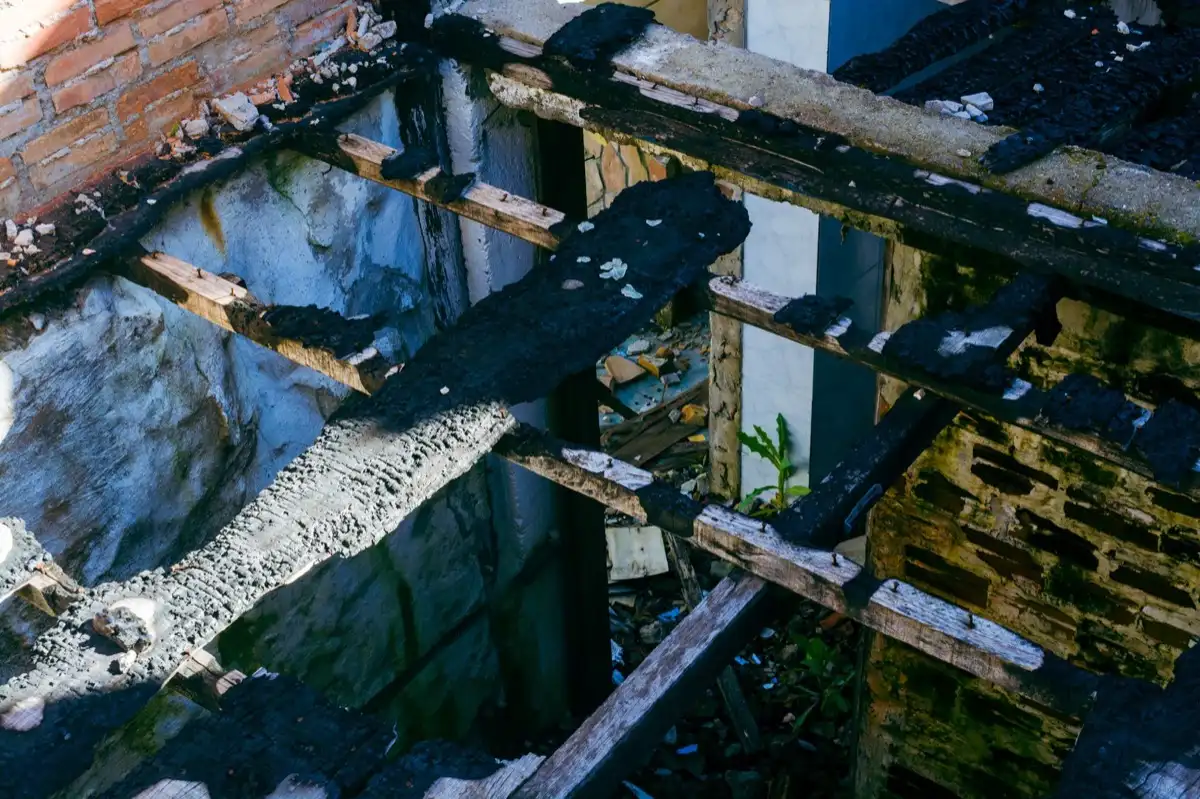
Nobody can price a roof leak over the phone, and it is not evasion. "Roof leak" names a category, not a job. The same brown ring on the same ceiling is a rubber collar and half an hour on the surface, or two days with a saw, new sheathing and a drywall crew behind it.
That gap is wider than the gap between any two contractors' rates, which makes "what does this cost" the wrong first question. The right one is which of the two you have.
Why the published range is too wide to quote from
The national cost guides are not dishonest. They are useless as a quote, and the proof is inside them.
Fixr puts roof leak repair between roughly $350 and $1,500. Modernize puts most roof repair between $350 and $1,900, and leaks from about $200 to $2,200 and up. Angi 403s to us; snippets show it near $400 to $1,900. Their central figures disagree by close to half again, because they average different scopes in different metros.
Inside a single guide, the line items disagree with each other far more violently than the guides disagree with each other. Fixr's chimney leak line runs about seventeen to one end to end. One line, one heading, one supposed job.
That describes a category, not your roof, so the rest of this is ratios.
The leak that only shows up in heavy rain
The most diagnostic thing a homeowner can notice, and nobody asks about it.
A leak in any steady rain is usually a hole. Gravity is sufficient — a cracked pipe boot, a backed-out nail, four lag holes from an antenna somebody unbolted in 2009. The rain only sets how fast the bucket fills.
A leak only when the rain is driven sideways is usually a wall or a flashing detail, not the field of the roof. Laps are built for water falling down; wind moves it sideways and upward, through a lap gravity alone could never push it through. IIBEC's guidance on water penetration in building envelopes says as much: wind drives water through openings and up a vertical surface, and the overlap must be tall enough to hold it there.
So "only in a storm, and only when it blows from the west" makes the west-facing walls the suspect list: sidewall step flashing, a missing kickout, a headwall termination where siding was brought down tight. Or the cladding itself — lap siding and brick veneer leak by design, and the flashing behind them is what catches it.
The wind-only leak is also the widest-variance repair here, and the one most often misdiagnosed as a roof and sold as one: a kickout at an accessible corner is close to nothing; opening siding to weave flashing in behind the barrier is not. Details in flashing on a roof.
A leak that needs hours of rain before it shows is a third case: overflow rather than pressure, and often the gutters.
Signs of a roof leak, in the order they get expensive
The sign tells you how long it has been running, and duration is the largest multiplier on the invoice.
Cheap, if you act on it. Rust rings on nail points in the attic. A dark line down a rafter edge. Sheathing damp on a wet day, dry on a dry one.
Middling. A ceiling stain with a hard ring at its edge — repeated wetting and drying, not one event. Bubbled paint, a musty attic, matted insulation.
Expensive. Decking that gives underfoot. Sagging drywall. Sheathing delaminating into layers. Mold under the deck. That is a roof repair plus carpentry plus, frequently, an interior trade.
The deceptive one. Peeling paint or a soft trim board below a dormer with no ceiling stain anywhere. That water went behind the siding at a missing kickout, and never makes the sign everybody watches for.
Working any of these back to the actual entry point is its own process, and it has its own method.
What you are actually buying, as ratios
| Repair | What it really is | Relative labor |
|---|---|---|
| Nail pop or mount hole | A fastener and a dab of cement | Minutes |
| Pipe boot | A part, half an hour on the surface | The baseline |
| Step flashing at a wall | Courses off, new metal per course, re-lay | Hours of skilled work |
| Valley | Cutting into a live assembly, both planes | Never a minimum call |
| Wet decking | Carpentry, sheet goods, a second trade | A small project |
Fixr's line items show the shape: at the midpoint a valley leak runs roughly twice a vent boot, and the chimney line stretches from the level of a boot to many times it. Modernize's decking figure sits above the midpoint of its own whole leak-repair range. Rot is not an adder. It is a different job that arrived inside the first one.
Across that table the parts spread by single-digit multiples and the labor by an order of magnitude. You are buying the truck, the ladder, the hour and somebody who knows which lap goes over which, which is why two repairs on one visit cost far less than two visits.
Roof leak in a valley: concentrated water, and a live assembly
A valley is where two roof planes hand their water to one line, and it takes far more of it per foot than open field ever does, faster. The consequence for a repair budget is that valleys generate calls out of all proportion to the share of the roof they occupy; the geometry driving that is set out in hips and valleys.
That is half the reason valley repairs price as they do. The other half is that you are cutting into something currently working: shingles are cut or woven in, so reaching the metal means opening both planes back a course or two and rebuilding the laps in order. A closed-cut valley is worse again, because there the shingles are the valley.
Valleys concentrate consequences as well as water: after two winters of leaking the deck beneath one is the wettest on the roof, which makes it the repair most likely to turn into the decking row above.
Metal roof leak: gaskets and movement, not shingles
Metal changes the economics, and which kind of metal changes them again.
Exposed-fastener panels — ribbed panels screwed straight through the face — are held by screws with a rubber washer under the head, and at each point the washer is the roof. Manufacturers rate EPDM washers at decades; installers report nearer twenty years, degraded by ultraviolet above and by the panel working underneath.
That last part matters. The panels are pinned at every screw and cannot move with temperature, so expansion and contraction goes into the hole. The trade calls it slotting: the fastener wallows an oval, and once the oval is wider than the washer the roof is open. McElroy Metal's guidance is standing seam, which floats on clips, for runs of about forty feet and up.
So a metal leak is rarely one leak: every screw has had the same sun and the same cycling, so when one washer goes the rest are close behind. The repair is re-fastening an area — usually a size up in screw diameter so fresh threads bite unworn metal, which Bill Ragan Roofing calls a five-to-ten-year cycle — priced by fastener count, nearer a small re-roof than a service call. Fixr puts metal at roughly double asphalt at both ends, which is where metal roofing replacement enters.
Standing seam leaks are usually at penetrations and terminations, not at the seam, and need somebody who works in that system. Either way, no asphalt roof cement on metal to buy time: it hides the slot and has to come off first.
What moves the number more than the repair does
Four things, and none of them is the part.
Access. Two stories, no truck access, a courtyard, planting nobody can crush. Staging instead of a ladder changes the day, not the hour.
Pitch. Walkable and not-walkable is a step change, not a gradient. Past roughly 7:12 the crew is on roof jacks and tied off, and the same repair takes more hours.
Layers. Two or three layers of old shingles means more comes off to reach anything, and deck work means all of it comes off.
Whether the deck is wet. The one that decides the rest. A dry deck keeps the job inside roofing; a wet deck adds carpentry, sheet goods and often drywall, which is why a serious quote gives a unit price for sheathing, not a flat total.
Geography moves this less than people assume: Modernize's state table has the priciest states about half again the cheapest for the same minor repair, while scope on that page spreads by ten. So ask for diagnosis and repair quoted separately, and get a written roof inspection with photographs.
What Illinois asks of whoever takes the money
Part of a repair is paying somebody the state permits to be paid, and the answers differ in kind rather than degree — including states that set no bar.
Illinois is one of very few states with a roofing license of its own, and there is no dollar threshold - any roofing work for pay requires one. Limited covers residential buildings up to eight units; unlimited adds commercial and industrial. The bond is ten thousand dollars for limited and twenty-five thousand for unlimited, and an exam covering Illinois jurisprudence is required. Working without the license is a Class A misdemeanor, a felony the second time.
The deductible, and the offer to make it disappear
Set the ratios above against your own deductible and most single-detail jobs land underneath it, which is why a leak is usually a purchase and not a filing. The pitch that flips it into the other thing arrives with an offer to absorb the difference.
Illinois bans this twice over. A contractor may not advertise or promise to pay or rebate any part of your deductible, and that reaches allowances, discounts off the fee, and any payment to you or to anyone connected with the property. Since August 2025 your contract must also carry an affirmative notice saying the roofer cannot do it. A first offense is a Class A misdemeanor, a later one a felony, plus civil penalties.
When the leak really is a claim job
Sometimes the leak is storm damage and belongs in a claim. What that changes about the contract you sign — as against whether the loss is covered, which is its own subject — is a state question.
Two clocks run in Illinois. Every roofing contract signed since August 2025 must contain a rescission clause giving you seventy-two hours and a full refund of your deposit. Separately, after a storm that damaged more than one home, you may cancel at the earlier of five business days after a denial notice or thirty business days after the insurer received your proof of loss - so that right can expire before the insurer has decided anything.
Bottom line
Get the entry point identified before pricing anything, and say whether the leak happens in all rain or only in driven rain — that alone separates cheap repairs from expensive ones. Expect the parts to be trivial and the labor not to be. And get sheathing priced per sheet up front, because that line decides whether you had a repair or a project.
Decatur Roof Pros does leak diagnosis with photographs, roof leak repair, roof inspections and metal roofing work across Decatur and Macon County and the middle Sangamon valley. Call (888) 402-7859 and we will find where the water gets in before anybody quotes.
Ready for a free quote in Decatur?
Decatur Roof Pros — free estimate, clear scope, no pressure. Use the form on this page or jump to the homepage quote.
Related services in Decatur
Decatur Roof Pros money pages — go straight to the service you need.
- Roof Leak Repair →
A leak on a doubled-up roof does not behave like a leak on a single one. Water that gets past the top course travels sideways in the space between the two, sometimes for several feet, before it finds a way down through the deck.
- Roof Inspections →
Our inspection answers a different first question than most. Before condition, before age, before anything about product, we establish how many roof coverings are on the building and we put that number at the top of the report.
- Metal Roofing →
Metal is the covering the code treats most generously as a recover, and it is also the one we most often talk Decatur homeowners out of putting on the main house. Those two facts are not in tension once you look at the numbers.
- Roof Replacement →
Replacement here begins with a number that has nothing to do with your roof's age. How many coverings are already up there decides whether you have a choice at all, and most people who call us have never once been told theirs.
- Storm Damage Restoration →
A storm is the moment your layer count stops being private. The adjuster measures it the same way we do, writes it into the file, and it shapes what the carrier believes it owes you long before anyone talks about shingle brands or colors.
Frequently asked questions
How much does it cost to fix a leak in a roof?
Published national guides land somewhere between roughly $350 and $1,900, and the width of that spread is the honest answer rather than a dodge. The same heading covers a rubber collar and half an hour on the roof, and two days of carpentry with new sheathing and a drywall trade behind it. Nobody can tell you which one you have without finding the entry point, and the entry point is almost never directly above the ceiling stain.
Why do two roofers quote completely different amounts for the same leak?
Usually because they are quoting two different jobs. One of them traced the leak and is pricing a specific repair; the other is pricing a guess with room in it. The other common cause is sheathing. A quote that assumes the deck is dry and a quote that carries a per-sheet price for wet decking are not comparable numbers, and only one of them will survive the day. Ask both to state what they found and how sheathing is priced.
My roof only leaks in heavy rain. Is that better or worse?
It is different, and it is the most useful thing you can tell a roofer. A leak that shows up in any steady rain is usually a hole, because gravity is enough.
A leak that shows up only when rain is being driven sideways is usually a wall or flashing detail, because wind pressure pushes water through a lap that gravity alone would never move it through.
That points at sidewalls, kickouts, headwall terminations and the cladding rather than at the open field of shingles, and it can be either the cheapest repair on the roof or the most expensive one, depending on whether siding has to come off.
Is a valley leak more expensive than a pipe boot?
Substantially, and for two reasons. A valley carries the concentrated runoff of two roof planes, so the assembly is under more load than anywhere else on the roof, and repairing it means cutting into something that is currently working.
Shingles are cut or woven into a valley, so both planes open back a course or two before any metal is reached. Fixr's own line items put a valley leak at roughly twice a vent boot at the midpoint, and the deck under a long-running valley leak is the wettest deck on the roof.
Why is a metal roof leak priced differently from a shingle leak?
Because the failure is rarely local. On exposed-fastener panels the rubber washer under every screw head is the roof at that point, and every screw on the building has had the same sun and the same thermal cycling, so when one is finished the rest are close behind.
The genuine repair is re-fastening an area rather than sealing a point, priced by fastener count, which is closer to a small re-roof than to a service call. Fixr puts metal leak repair at roughly double asphalt at both ends of its range.
Does a roof leak always mean the decking is wet?
No, and that is the single line that decides whether this is a repair or a project. Duration is what soaks a deck, not severity. A leak caught while the attic sheathing is still damp on wet days and dry on dry ones stays a roofing job.
A leak that has run through two winters brings in carpentry, sheet goods and often an interior trade. Ask for sheathing to be priced per sheet in the contract rather than carried as an allowance.
Local context
How this applies in Decatur, IL
Every article here is written from roofing work done in Decatur and Macon County and the middle Sangamon valley, so the numbers reflect local labour, permit and material costs rather than a national average. Your own job can land either side of them depending on access, the condition of what is already there, and the materials you pick — layer count established by lifting a tab at the rake and again at an eave, nesting a new course into the butt line of the covering below it, fasteners long enough to reach three quarters of an inch into the deck.
The way to turn any of this into a real answer is to have someone look at your actual situation. The free estimate is free, itemized and written down, with no deposit and no obligation. Call (888) 402-7859 or start on the Decatur Roof Pros homepage.
Areas Decatur Roof Pros covers
Decatur first, then the surrounding communities of Macon County and the middle Sangamon valley. Each has its own page with local detail rather than a copy of this one:
- Mount Zion, IL — Macon County, population 6,019
- Forsyth, IL — Macon County, population 3,734
- Argenta, IL — Macon County, population 913
- Maroa, IL — Macon County, population 1,577
- Warrensburg, IL — Macon County, population 1,110
- Blue Mound, IL — Macon County, population 1,133
Or jump to the full list of Decatur services.
More from the Decatur Roof Pros blog
- Cost for Gutter Installation in Decatur, IL: Priced by the Foot
Gutters are quoted per linear foot, and the foot price hides most of the job. What moves a gutter bid in Decatur, IL, and what a bad install costs later.
- Can You Claim a New Roof on Your Taxes? Usually No — Here's What People Actually Mean
A roof on your own home is not deductible. It adds to your basis, which matters when you sell.
- Attic Ventilation Calculator for a Decatur, IL Roof
Work out your own attic ventilation number in Decatur, IL: floor area, the 1/150 or 1/300 divisor, square inches of net free area, and how many vents.
The Decatur Roof Pros Team
roofing specialists serving Decatur, IL
Written by the Decatur Roof Pros team — insured roofing pros serving Decatur, IL and the surrounding area.